Plan with confidence
Choosing a renovation contractor in Athens: a practical comparison guide
Compare renovation contractors in Athens using the same scope, clear responsibilities, evidence of relevant work and a practical communication plan.
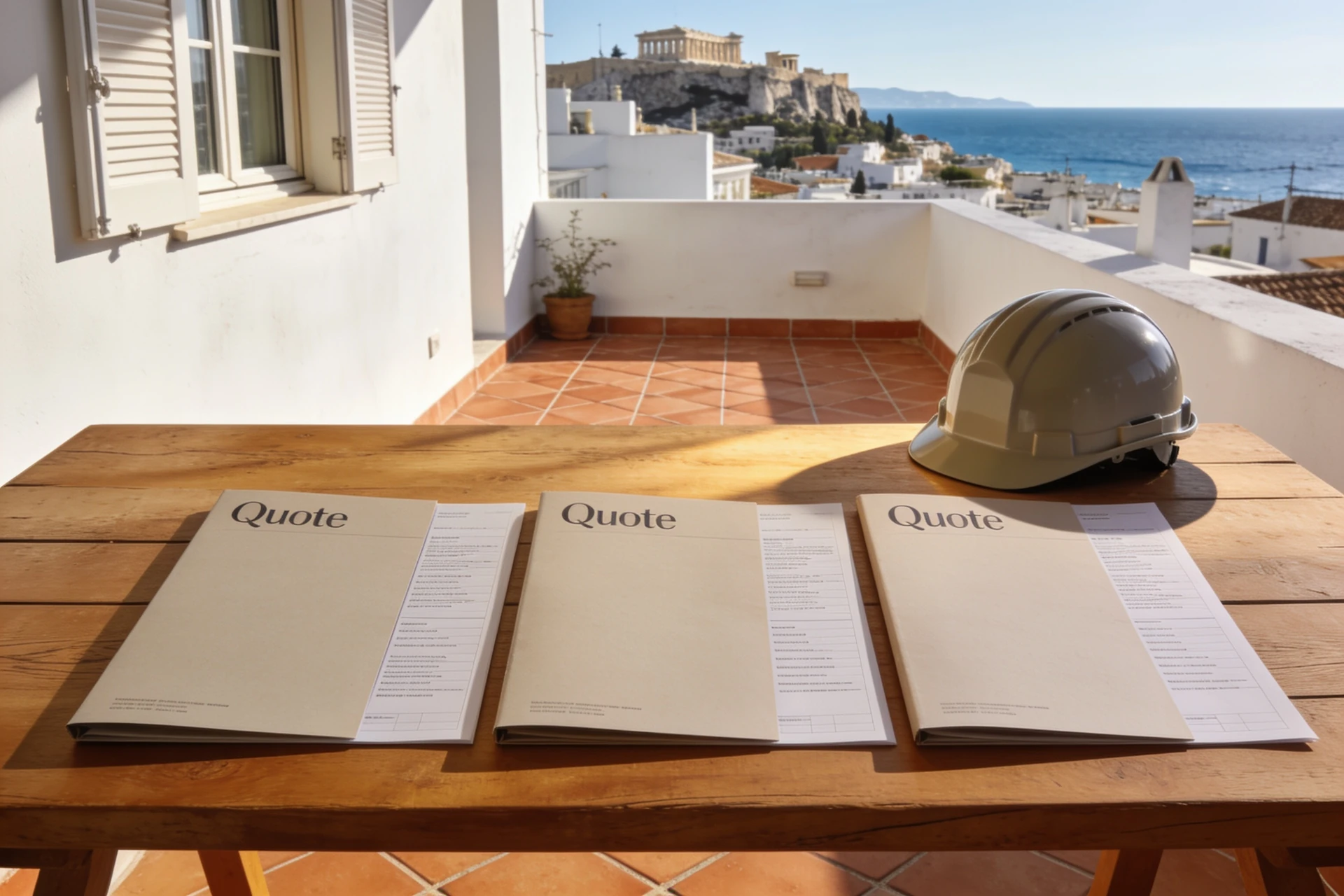
Choosing a contractor becomes easier when you stop comparing sales presentations and start comparing how the work will be delivered. For an Athens apartment, access, neighbours, existing services and decisions made by the owner can affect the project as much as the visible finishes. This guide sets out a practical selection process you can use before committing to a quotation.
At a glance: Prepare one brief, compare written inclusions, check who will manage the work and speak to relevant references. A low headline price is not enough information to choose a team.
Prepare one brief before collecting quotations
Write down the property, the rooms involved and the problems you want to solve. Separate essential work from optional improvements. Include measured drawings if available, photographs of existing conditions and the finishes you have already chosen. State whether you will live at the property, who will make decisions and any fixed dates the team should know about.
Give every candidate the same information. If one company prices a complete kitchen replacement and another assumes that existing plumbing stays, their totals are not comparable. A short, consistent brief is more useful than a large folder of inspiration images with no indication of what is actually included.
Compare responsibility, not only the list of trades
Ask who is responsible for the overall programme, who coordinates subcontractors and who checks that completed work matches the drawings. Clarify the role of your engineer or designer. The person selling the project may not be the person answering daily questions on site, so ask to meet the proposed contact before you make your decision.
Look for boundaries that could leave a task without an owner. Who measures for cabinetry after the walls are finished? Who confirms appliance requirements? Who protects shared areas and removes waste? Record these responsibilities alongside the quotation. A team that can explain interfaces clearly gives you something concrete to assess.
Request evidence that matches your project
A portfolio can demonstrate style, but it cannot tell you how a team handles an occupied apartment, a difficult delivery route or a change to the specification. Ask for examples with a similar scope and constraints. With the previous client's permission, ask what communication was like, how changes were priced and whether handover information was complete.
Do not assume every image in a presentation shows work performed by the company. Ask which parts were delivered by its team and whether photographs represent completed projects or design concepts. This is especially useful when comparing polished websites: attribution and a clear explanation of responsibility matter more than the number of attractive pictures.
Read the quotation line by line
Create a comparison sheet with one row for each work package. Record the specified product or finish, quantity assumptions, installation, preparation, protection, waste removal and exclusions. Mark provisional allowances separately. If the supplier has not yet been selected, ask how the final cost will be calculated and how you will approve it.
For example, a bathroom quotation labelled 'new tiles' may cover only laying tiles, while another includes removal, substrate preparation, waterproofing, trims and installation. This is an illustrative comparison, not a statement about any particular contractor. The purpose is to identify what each price buys before negotiating the total.
Test the communication process
Ask what a normal weekly update contains. A useful update identifies completed work, decisions needed, upcoming deliveries and changes to the programme. Agree where drawings and approved selections are stored so that an old message does not become the accidental specification. One named owner representative also reduces contradictory instructions.
Raise a realistic scenario: you decide to change a worktop after ordering. Ask how the team records the request, checks the effect on cost and timing, and obtains approval. The answer should describe a process rather than a promise that changes are never a problem. Keep decisions in writing even when the conversation itself is friendly and informal.
Make the final decision with the gaps visible
Before signing, resolve unclear exclusions, confirm who supplies owner-selected items and identify the documents you expect at handover. Have contractual or regulatory questions reviewed by the appropriate professional. This article is a project-selection checklist, not a substitute for legal advice or an engineer's assessment of the proposed works.
Choose the proposal you understand and can manage, not simply the one with the shortest programme or lowest number. If a candidate cannot yet answer a question, record it as unresolved rather than filling the gap with an assumption. A clear decision today is easier to defend than an optimistic interpretation discovered halfway through construction.
What to compare in each proposal
| Area | Useful evidence | Question to resolve |
|---|---|---|
| Scope | Room-by-room inclusions and exclusions | Are preparation and making good included? |
| Management | Named site contact and responsibilities | Who coordinates suppliers and trades? |
| Changes | Written variation process | When do I approve the price and delay? |
| Handover | Documents and completion checklist | What will I receive before the job closes? |
Frequently asked questions
Should I always choose the lowest quotation?
Only after comparing the same scope and understanding the exclusions. A lower price may reflect a different specification, an omitted task or a different allowance. Ask for those differences to be made explicit before deciding whether it offers better value.
How many quotations should I collect?
Collect enough well-defined proposals to compare approaches and costs without turning the process into an endless exercise. The quality of the information matters more than a fixed number. If every proposal interprets the work differently, improve the brief before requesting more.
Can photographs replace references?
No. Photographs show an outcome or a design intention; references can help explain the working process. Use both, and ask permission before contacting a previous client or visiting a property.
Your practical checklist
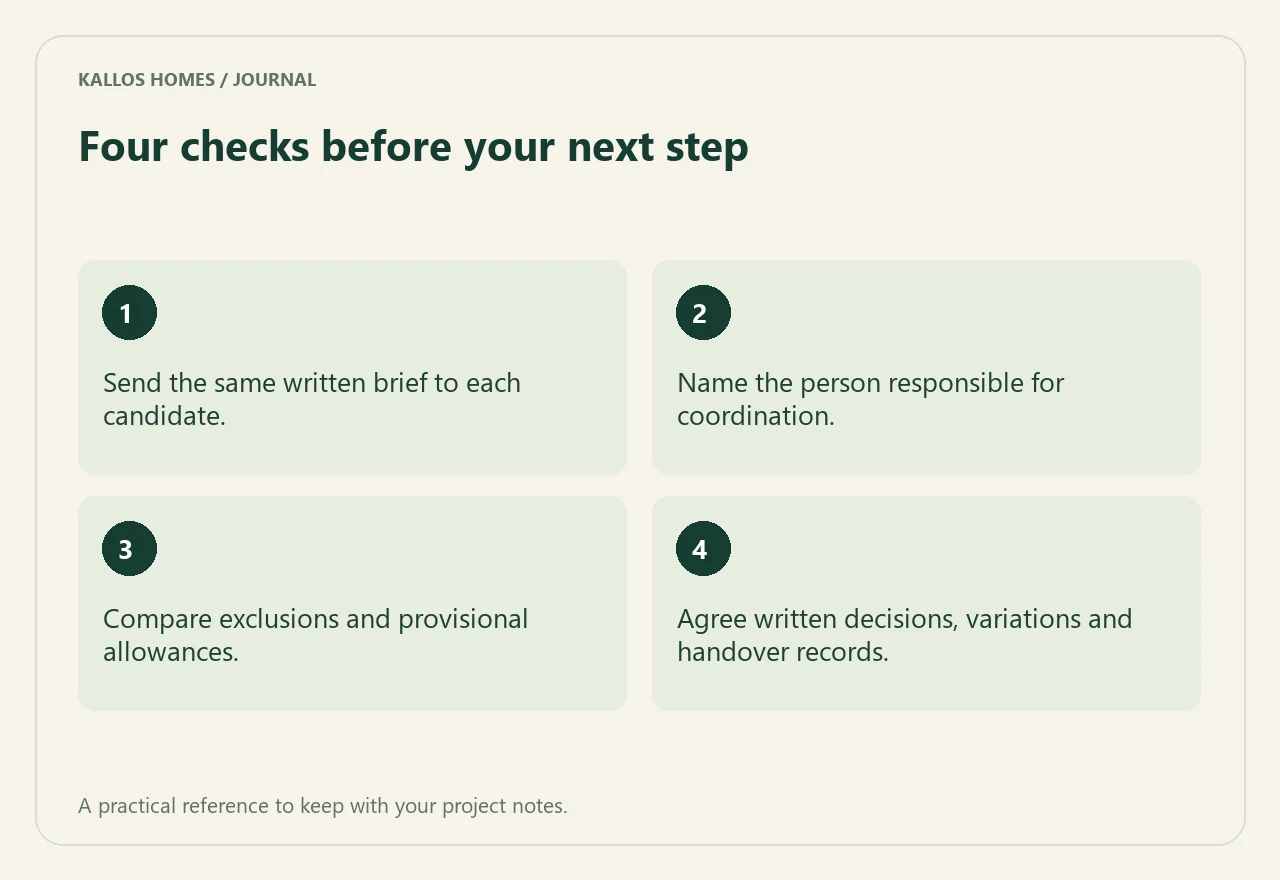
- Send the same written brief to each candidate.
- Name the person responsible for coordination.
- Compare exclusions and provisional allowances.
- Agree written decisions, variations and handover records.